Question 10: Our marketing team wants to move off Google Analytics 4. What should we use instead, and how hard is the migration?
Google Search, AI Overview block, captured 2026-10-31 17:49:21 UTC
MentionedNot recommendedLinked to your site
Screenshot
The answer
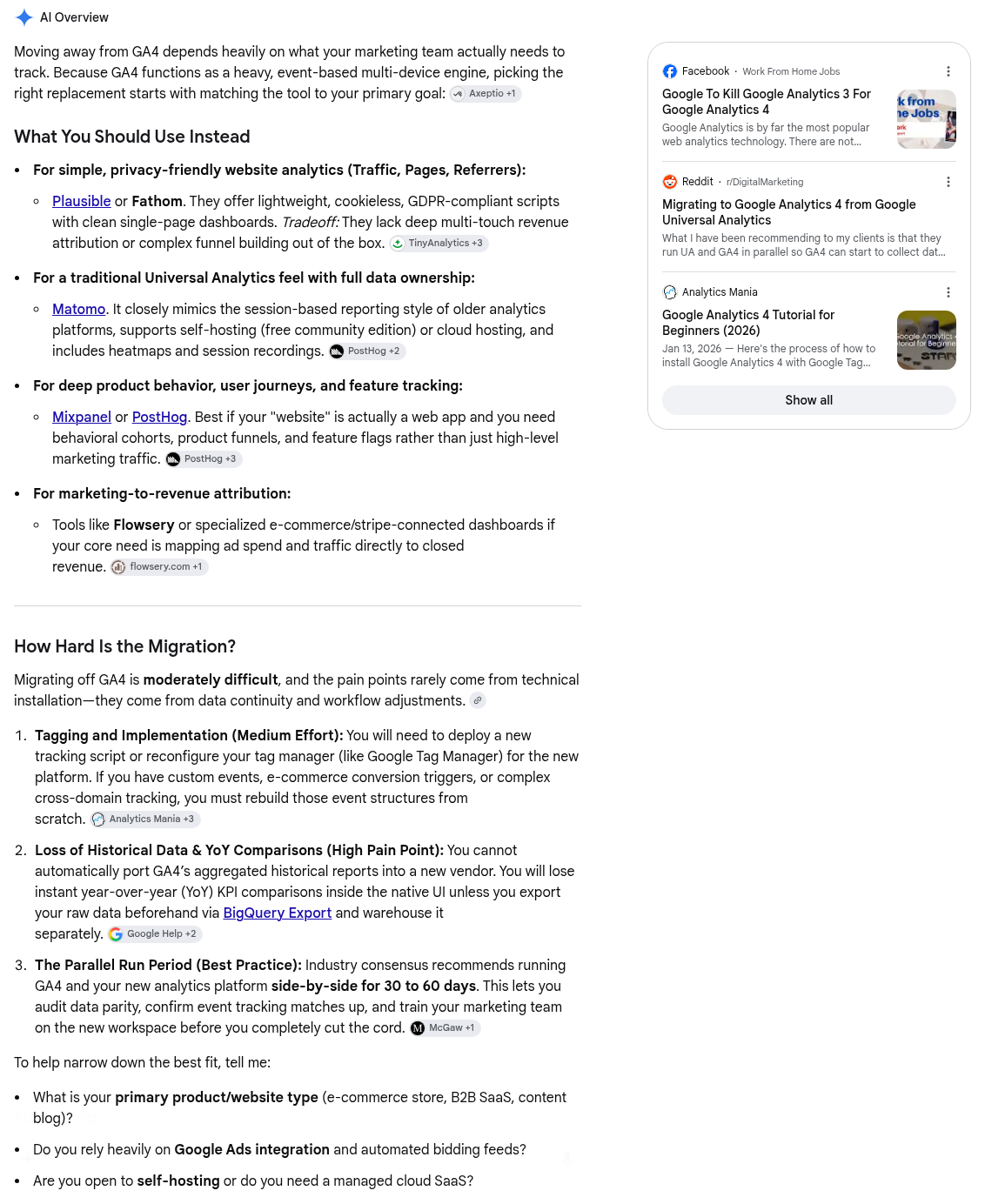
Moving away from GA4 depends heavily on what your marketing team actually needs to track. Because GA4 functions as a heavy, event-based multi-device engine, picking the right replacement starts with matching the tool to your primary goal:
What You Should Use Instead
For simple, privacy-friendly website analytics (Traffic, Pages, Referrers):
Plausible or Fathom. They offer lightweight, cookieless, GDPR-compliant scripts with clean single-page dashboards. Tradeoff: They lack deep multi-touch revenue attribution or complex funnel building out of the box.
For a traditional Universal Analytics feel with full data ownership:
Matomo. It closely mimics the session-based reporting style of older analytics platforms, supports self-hosting (free community edition) or cloud hosting, and includes heatmaps and session recordings.
For deep product behavior, user journeys, and feature tracking:
Mixpanel or PostHog. Best if your "website" is actually a web app and you need behavioral cohorts, product funnels, and feature flags rather than just high-level marketing traffic.
For marketing-to-revenue attribution:
Tools like Flowsery or specialized e-commerce/stripe-connected dashboards if your core need is mapping ad spend and traffic directly to closed revenue.
How Hard Is the Migration?
Migrating off GA4 is moderately difficult, and the pain points rarely come from technical installation—they come from data continuity and workflow adjustments.
Tagging and Implementation (Medium Effort): You will need to deploy a new tracking script or reconfigure your tag manager (like Google Tag Manager) for the new platform. If you have custom events, e-commerce conversion triggers, or complex cross-domain tracking, you must rebuild those event structures from scratch.
Loss of Historical Data & YoY Comparisons (High Pain Point): You cannot automatically port GA4’s aggregated historical reports into a new vendor. You will lose instant year-over-year (YoY) KPI comparisons inside the native UI unless you export your raw data beforehand via BigQuery Export and warehouse it separately.
The Parallel Run Period (Best Practice): Industry consensus recommends running GA4 and your new analytics platform side-by-side for 30 to 60 days. This lets you audit data parity, confirm event tracking matches up, and train your marketing team on the new workspace before you completely cut the cord.
To help narrow down the best fit, tell me:
What is your primary product/website type (e-commerce store, B2B SaaS, content blog)?
Do you rely heavily on Google Ads integration and automated bidding feeds?
Are you open to self-hosting or do you need a managed cloud SaaS?
Text as shown by the app, with page buttons and source badges removed. Marked yellow: the brand; underlined: competitors.
Links in the answer (16)
| Site | Link |
|---|---|
| axept.io | Axeptio |
| plausible.io | Plausible |
| tinyanalytics.io | TinyAnalytics |
| matomo.org | Matomo |
| posthog.com | PostHog |
| mixpanel.com | Mixpanel |
| posthog.com | PostHog |
| posthog.com | PostHog |
| flowsery.com | https://flowsery.com/blog/best-google-analytics-alternatives |
| analyticsmania.com | Analytics Mania |
| mcgaw.io | McGaw |
| facebook.com | Google To Kill Google Analytics 3 For Google Analytics 4 |
| reddit.com | Migrating to Google Analytics 4 from Google Universal Analytics |
| databuddy.cc | Migrating from Google Analytics? The best alternatives in 2026 |
| reddit.com | Best Google Analytics alternative in 2026 if you care ... - Reddit |
| youtube.com | Plausible Vs Matomo Which Web Analytics Tool Is Better in ..., Video, watch on YouTube |