Question 9: What website analytics would you recommend for a dental clinic website in California that wants to limit tracking?
Google Search, AI Overview block, captured 2026-10-31 17:49:01 UTC
MentionedNot recommendedLinked to your site
Screenshot
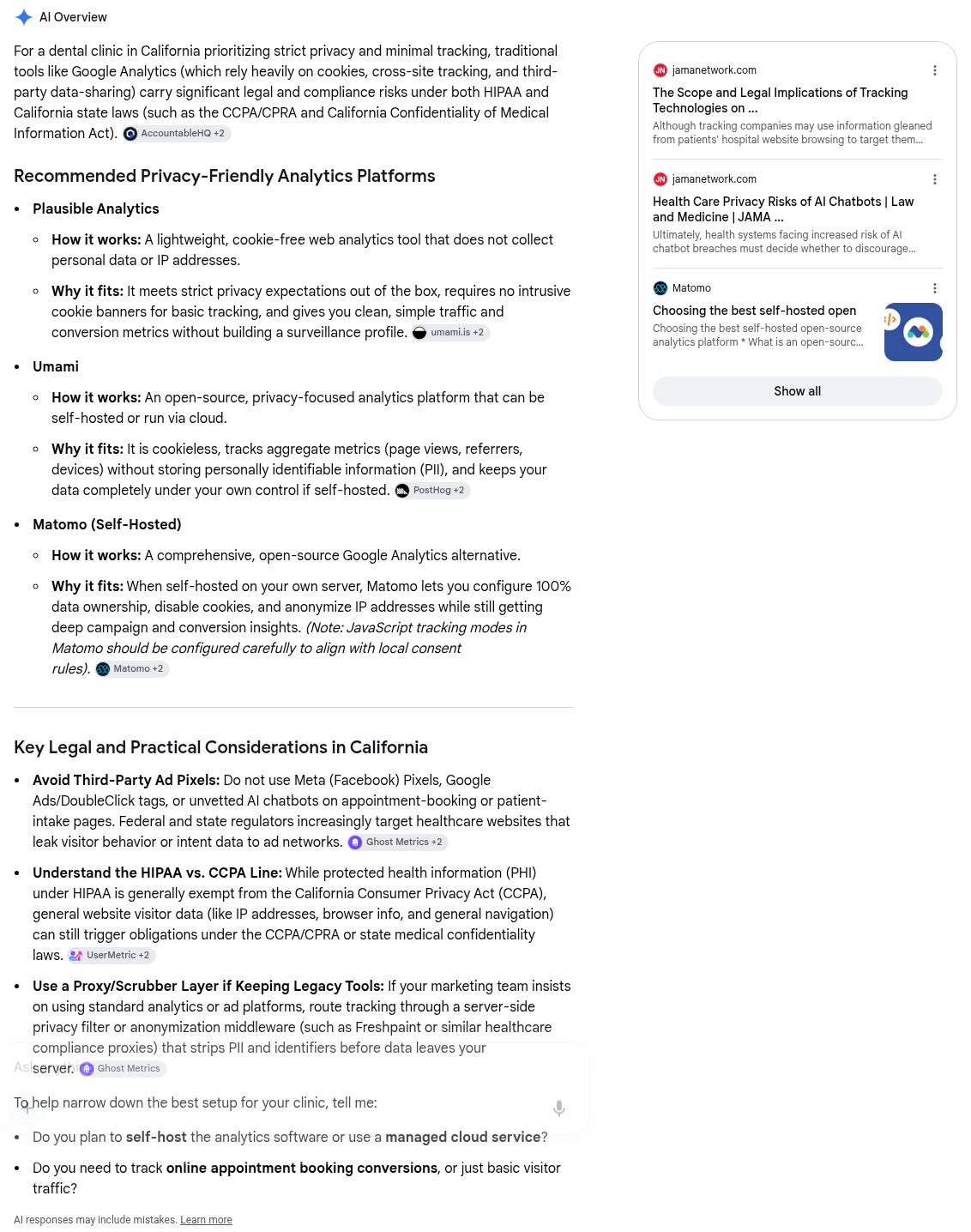
The answer
For a dental clinic in California prioritizing strict privacy and minimal tracking, traditional tools like Google Analytics (which rely heavily on cookies, cross-site tracking, and third-party data-sharing) carry significant legal and compliance risks under both HIPAA and California state laws (such as the CCPA/CPRA and California Confidentiality of Medical Information Act).
Recommended Privacy-Friendly Analytics Platforms
Plausible Analytics
How it works: A lightweight, cookie-free web analytics tool that does not collect personal data or IP addresses.
Why it fits: It meets strict privacy expectations out of the box, requires no intrusive cookie banners for basic tracking, and gives you clean, simple traffic and conversion metrics without building a surveillance profile.
Umami
How it works: An open-source, privacy-focused analytics platform that can be self-hosted or run via cloud.
Why it fits: It is cookieless, tracks aggregate metrics (page views, referrers, devices) without storing personally identifiable information (PII), and keeps your data completely under your own control if self-hosted.
Matomo (Self-Hosted)
How it works: A comprehensive, open-source Google Analytics alternative.
Why it fits: When self-hosted on your own server, Matomo lets you configure 100% data ownership, disable cookies, and anonymize IP addresses while still getting deep campaign and conversion insights. (Note: JavaScript tracking modes in Matomo should be configured carefully to align with local consent rules).
Key Legal and Practical Considerations in California
Avoid Third-Party Ad Pixels: Do not use Meta (Facebook) Pixels, Google Ads/DoubleClick tags, or unvetted AI chatbots on appointment-booking or patient-intake pages. Federal and state regulators increasingly target healthcare websites that leak visitor behavior or intent data to ad networks.
Understand the HIPAA vs. CCPA Line: While protected health information (PHI) under HIPAA is generally exempt from the California Consumer Privacy Act (CCPA), general website visitor data (like IP addresses, browser info, and general navigation) can still trigger obligations under the CCPA/CPRA or state medical confidentiality laws.
Use a Proxy/Scrubber Layer if Keeping Legacy Tools: If your marketing team insists on using standard analytics or ad platforms, route tracking through a server-side privacy filter or anonymization middleware (such as Freshpaint or similar healthcare compliance proxies) that strips PII and identifiers before data leaves your server.
To help narrow down the best setup for your clinic, tell me:
Do you plan to self-host the analytics software or use a managed cloud service?
Do you need to track online appointment booking conversions, or just basic visitor traffic?
Text as shown by the app, with page buttons and source badges removed. Marked yellow: the brand; underlined: competitors.
Links in the answer (10)
| Site | Link |
|---|---|
| accountablehq.com | AccountableHQ |
| umami.is | https://umami.is/blog/best-self-hosted-web-analytics-tools |
| posthog.com | PostHog |
| matomo.org | Matomo |
| ghostmetrics.io | Ghost Metrics |
| blog.usermetric.io | UserMetric |
| jamanetwork.com | The Scope and Legal Implications of Tracking Technologies on ... |
| jamanetwork.com | Health Care Privacy Risks of AI Chatbots Law and Medicine JAMA ... |
| nodion.com | Open Source Web Analytics: 5 Google Analytics Alternatives |
| plausible.io | Plausible vs Matomo: A simple, privacy-first alternative Plausible Analytics |