Question 7: Self-hosted or hosted privacy-friendly analytics - which is better for a small team, and which products fit each option?
Google Search, AI Overview block, captured 2026-10-31 17:48:20 UTC
MentionedNot recommendedLinked to your site
Screenshot
The answer
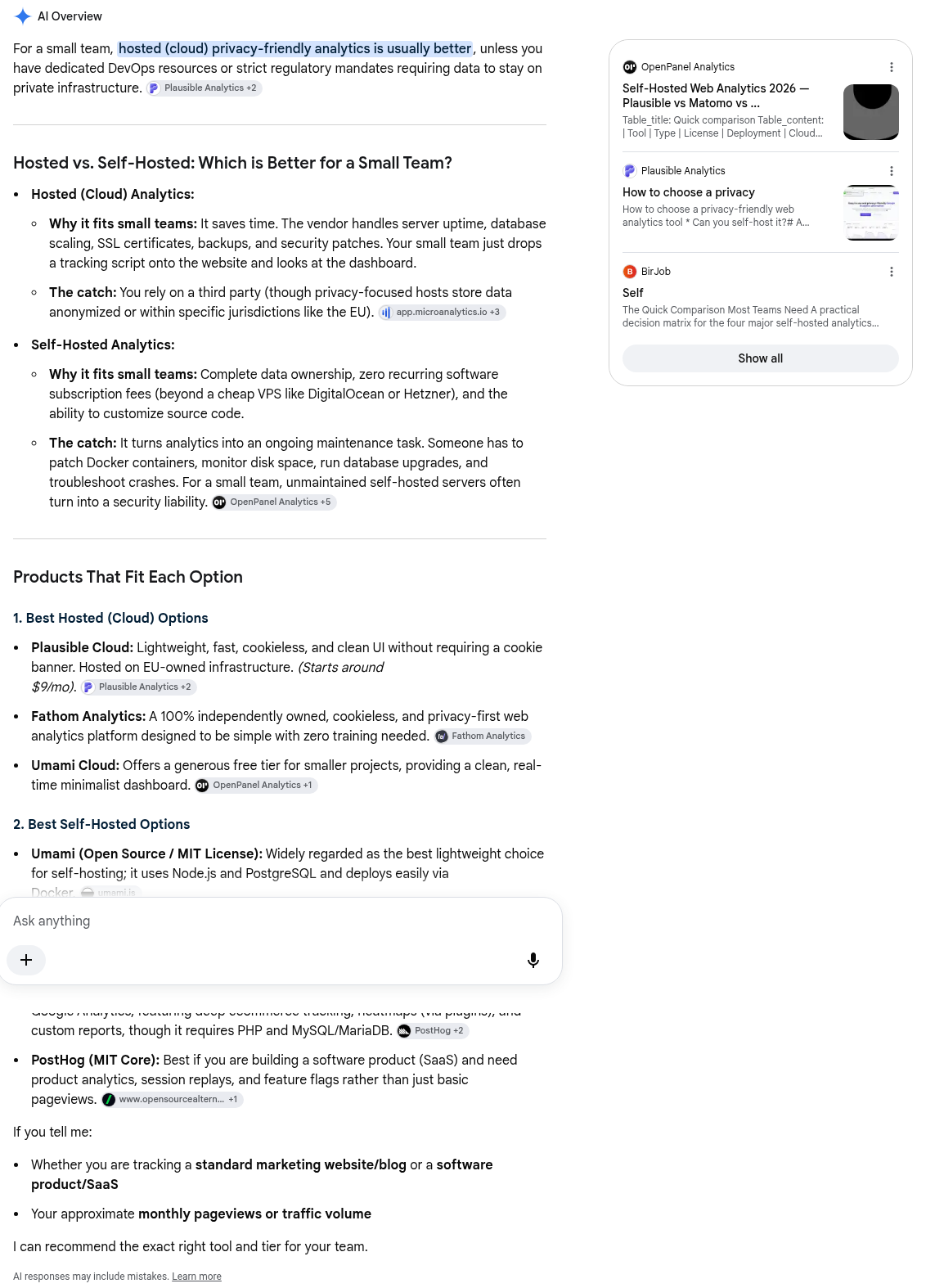
For a small team, hosted (cloud) privacy-friendly analytics is usually better, unless you have dedicated DevOps resources or strict regulatory mandates requiring data to stay on private infrastructure.
Hosted vs. Self-Hosted: Which is Better for a Small Team?
Hosted (Cloud) Analytics:
Why it fits small teams: It saves time. The vendor handles server uptime, database scaling, SSL certificates, backups, and security patches. Your small team just drops a tracking script onto the website and looks at the dashboard.
The catch: You rely on a third party (though privacy-focused hosts store data anonymized or within specific jurisdictions like the EU).
Self-Hosted Analytics:
Why it fits small teams: Complete data ownership, zero recurring software subscription fees (beyond a cheap VPS like DigitalOcean or Hetzner), and the ability to customize source code.
The catch: It turns analytics into an ongoing maintenance task. Someone has to patch Docker containers, monitor disk space, run database upgrades, and troubleshoot crashes. For a small team, unmaintained self-hosted servers often turn into a security liability.
Products That Fit Each Option
1. Best Hosted (Cloud) Options
Plausible Cloud: Lightweight, fast, cookieless, and clean UI without requiring a cookie banner. Hosted on EU-owned infrastructure. (Starts around $9/mo).
Fathom Analytics: A 100% independently owned, cookieless, and privacy-first web analytics platform designed to be simple with zero training needed.
Umami Cloud: Offers a generous free tier for smaller projects, providing a clean, real-time minimalist dashboard.
2. Best Self-Hosted Options
Umami (Open Source / MIT License): Widely regarded as the best lightweight choice for self-hosting; it uses Node.js and PostgreSQL and deploys easily via Docker.
Plausible Community Edition (AGPL-3.0): The free, open-source version of Plausible, though it requires a slightly heavier stack (Docker, PostgreSQL, and ClickHouse).
Matomo On-Premise (GPL-v3): The closest true open-source alternative to full Google Analytics, featuring deep ecommerce tracking, heatmaps (via plugins), and custom reports, though it requires PHP and MySQL/MariaDB.
PostHog (MIT Core): Best if you are building a software product (SaaS) and need product analytics, session replays, and feature flags rather than just basic pageviews.
If you tell me:
Whether you are tracking a standard marketing website/blog or a software product/SaaS
Your approximate monthly pageviews or traffic volume
I can recommend the exact right tool and tier for your team.
Text as shown by the app, with page buttons and source badges removed. Marked yellow: the brand; underlined: competitors.
Links in the answer (16)
| Site | Link |
|---|---|
| plausible.io | Plausible Analytics |
| app.microanalytics.io | https://app.microanalytics.io/articles/hosted-vs-self-hosted-web-analytics |
| openpanel.dev | OpenPanel Analytics |
| usefathom.com | Fathom Analytics |
| umami.is | https://umami.is/blog/best-self-hosted-web-analytics-tools |
| plausible.io | Plausible Analytics |
| posthog.com | PostHog |
| opensourcealternatives.to | https://www.opensourcealternatives.to/blog/self-hosted-analytics |
| birjob.com | Self |
| privacyanalytics.io | Self |
| youtube.com | Self-Hosted vs Cloud Software Explained (When to Choose ..., Video, watch on YouTube |
| reddit.com | Privacy vs Security - is Selfhosting a higher risk for your data ... |
| discuss.privacyguides.net | Does Privacy Guides have a stance on self-hosting? |
| youtube.com | Posthog Vs Umami Vs Plausible Which Web Analytics Tool Is ..., Video, watch on YouTube |
| youtube.com | 10 Self-Hosted Google Analytics Alternatives You Should Try, Video, watch on YouTube |
| matomo.org | Is Matomo truly free to use? What are the costs or requirements? |