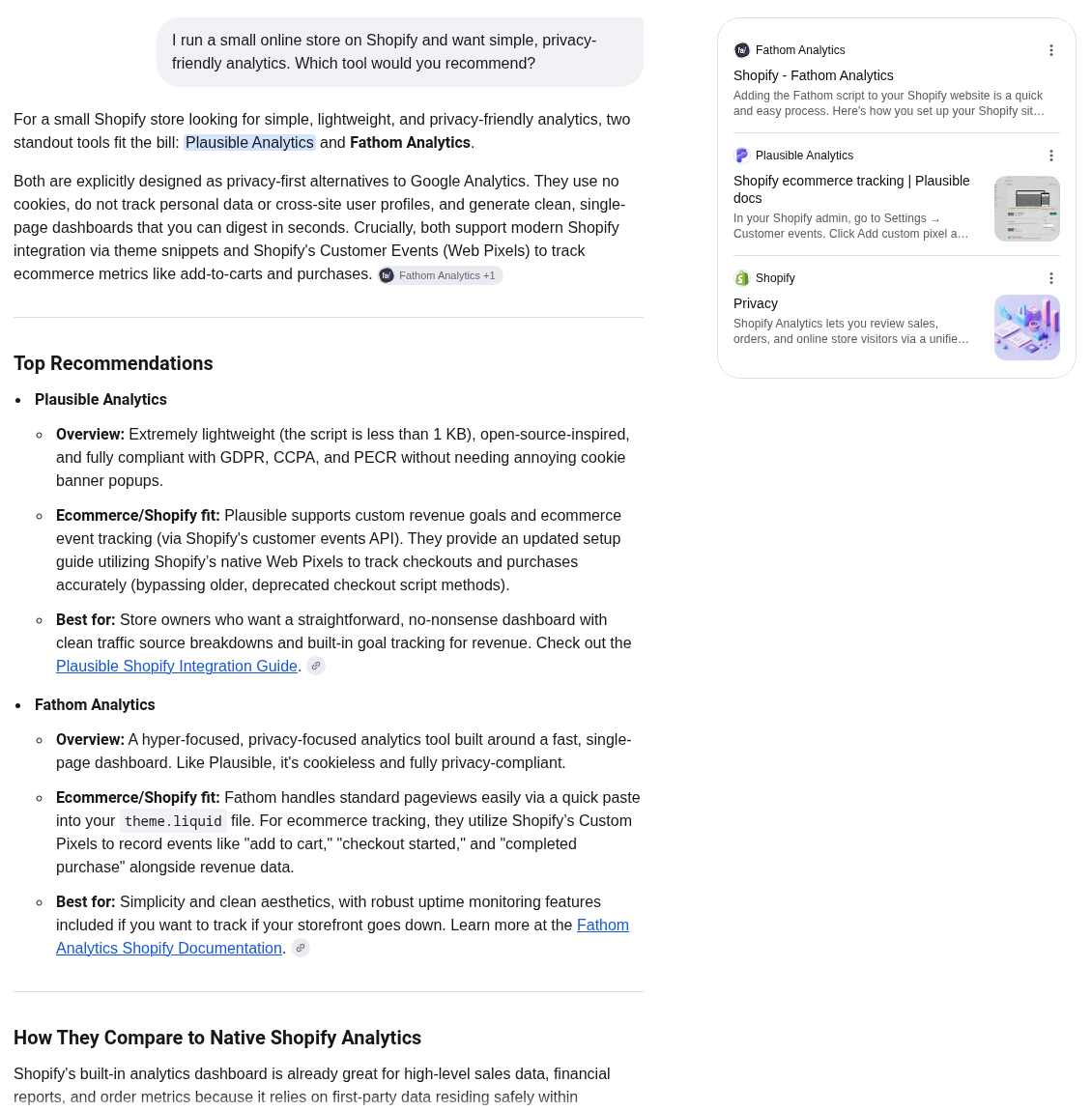
Question 5: I run a small online store on Shopify and want simple, privacy-friendly analytics. Which tool would you recommend?
Google Search, AI Mode, captured 2026-10-31 17:55:31 UTC
MentionedRecommendedLinked to your site
Screenshot
The answer
For a small Shopify store looking for simple, lightweight, and privacy-friendly analytics, two standout tools fit the bill: Plausible Analytics and Fathom Analytics.
Both are explicitly designed as privacy-first alternatives to Google Analytics. They use no cookies, do not track personal data or cross-site user profiles, and generate clean, single-page dashboards that you can digest in seconds. Crucially, both support modern Shopify integration via theme snippets and Shopify's Customer Events (Web Pixels) to track ecommerce metrics like add-to-carts and purchases.
Top Recommendations
Plausible Analytics
Overview: Extremely lightweight (the script is less than 1 KB), open-source-inspired, and fully compliant with GDPR, CCPA, and PECR without needing annoying cookie banner popups.
Ecommerce/Shopify fit: Plausible supports custom revenue goals and ecommerce event tracking (via Shopify's customer events API). They provide an updated setup guide utilizing Shopify’s native Web Pixels to track checkouts and purchases accurately (bypassing older, deprecated checkout script methods).
Best for: Store owners who want a straightforward, no-nonsense dashboard with clean traffic source breakdowns and built-in goal tracking for revenue. Check out the Plausible Shopify Integration Guide.
Fathom Analytics
Overview: A hyper-focused, privacy-focused analytics tool built around a fast, single-page dashboard. Like Plausible, it's cookieless and fully privacy-compliant.
Ecommerce/Shopify fit: Fathom handles standard pageviews easily via a quick paste into your theme.liquid file. For ecommerce tracking, they utilize Shopify’s Custom Pixels to record events like "add to cart," "checkout started," and "completed purchase" alongside revenue data.
Best for: Simplicity and clean aesthetics, with robust uptime monitoring features included if you want to track if your storefront goes down. Learn more at the Fathom Analytics Shopify Documentation.
How They Compare to Native Shopify Analytics
Shopify's built-in analytics dashboard is already great for high-level sales data, financial reports, and order metrics because it relies on first-party data residing safely within Shopify's infrastructure. However, native Shopify reports lack deep marketing attribution, behavioral flow details, and clean insights into where your non-purchasing web traffic is originating (such as specific external referrers or search engines). Pairing Shopify's native dashboard with a tool like Plausible or Fathom gives you the best of both worlds: robust sales tracking natively and clear, privacy-safe visitor behavior externally.
Shopify
Would you prefer an open-source/indie tool like Plausible, or are you interested in a platform that also bundles features like uptime monitoring (like Fathom)? Let me know and I can help outline how to map your specific tracking goals.
Text as shown by the app, with page buttons and source badges removed. Marked yellow: the brand; underlined: competitors.
Links in the answer (3)
| Site | Link |
|---|---|
| usefathom.com | Fathom Analytics |
| plausible.io | Plausible Shopify Integration Guide |
| shopify.com | Shopify |