Question 10: Our marketing team wants to move off Google Analytics 4. What should we use instead, and how hard is the migration?
Gemini web app (gemini.google.com), captured 2026-10-31 17:42:04 UTC
MentionedNot recommendedNot linked
Screenshot
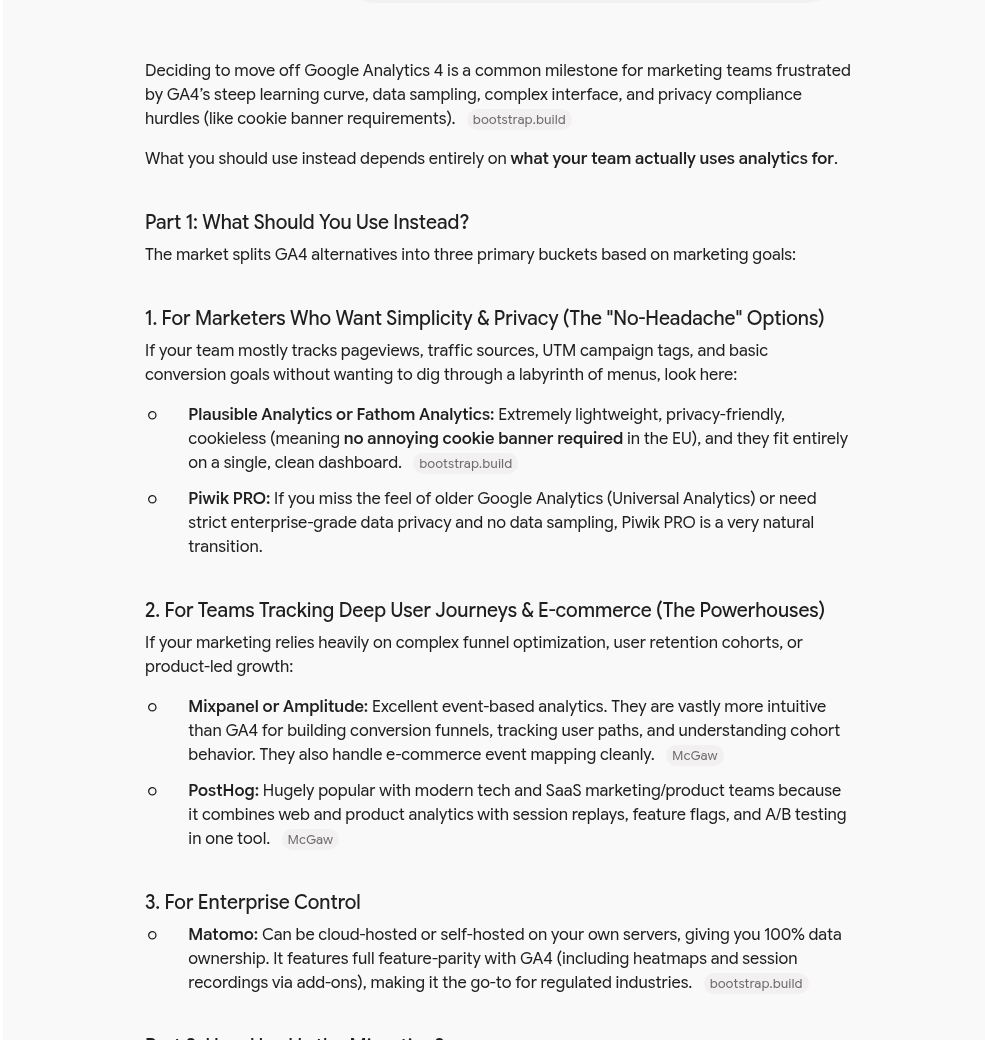
The answer
Deciding to move off Google Analytics 4 is a common milestone for marketing teams frustrated by GA4’s steep learning curve, data sampling, complex interface, and privacy compliance hurdles (like cookie banner requirements).
What you should use instead depends entirely on what your team actually uses analytics for.
Part 1: What Should You Use Instead?
The market splits GA4 alternatives into three primary buckets based on marketing goals:
1. For Marketers Who Want Simplicity & Privacy (The "No-Headache" Options)
If your team mostly tracks pageviews, traffic sources, UTM campaign tags, and basic conversion goals without wanting to dig through a labyrinth of menus, look here:
Plausible Analytics or Fathom Analytics: Extremely lightweight, privacy-friendly, cookieless (meaning no annoying cookie banner required in the EU), and they fit entirely on a single, clean dashboard.
Piwik PRO: If you miss the feel of older Google Analytics (Universal Analytics) or need strict enterprise-grade data privacy and no data sampling, Piwik PRO is a very natural transition.
2. For Teams Tracking Deep User Journeys & E-commerce (The Powerhouses)
If your marketing relies heavily on complex funnel optimization, user retention cohorts, or product-led growth:
Mixpanel or Amplitude: Excellent event-based analytics. They are vastly more intuitive than GA4 for building conversion funnels, tracking user paths, and understanding cohort behavior. They also handle e-commerce event mapping cleanly.
PostHog: Hugely popular with modern tech and SaaS marketing/product teams because it combines web and product analytics with session replays, feature flags, and A/B testing in one tool.
3. For Enterprise Control
Matomo: Can be cloud-hosted or self-hosted on your own servers, giving you 100% data ownership. It features full feature-parity with GA4 (including heatmaps and session recordings via add-ons), making it the go-to for regulated industries.
Part 2: How Hard Is the Migration?
The short answer: Technically easy, culturally and structurally moderate.
Moving off GA4 is rarely an overnight flip of a switch. Expect the migration to take anywhere from 2 to 4 weeks for basic setups, or up to 2 to 3 months if you are moving a massive enterprise data ecosystem.
The migration breaks down into three core phases:
Phase 1: Dual-Tagging / Parallel Run (1–2 Weeks)
What you do: Install the tracking snippet of your new platform (e.g., Plausible or Mixpanel) alongside your existing GA4 tags.
Why: Do not delete GA4 immediately. You need a validation window where both tools run simultaneously. Traffic counts, session lengths, and conversion events will rarely match 1:1 due to differing definitions of a "session" and how each tool handles ad-blockers or cookie consent. Running them in parallel lets you calibrate and build trust in the new numbers.
Phase 2: Mapping Events & UTM Discipline (1 Week)
What you do: Re-map your conversion goals and event triggers. If you use custom events in GA4 (e.g., button clicks, form submissions, newsletter signups), you'll need to configure equivalent triggers in your new tool.
Marketing Warning: Double-check your UTM parameter strategy. Most alternative tools rely heavily on clean UTM tagging (utm_source, utm_medium, utm_campaign) for attribution. If your team is sloppy with UTMs, your acquisition reports in a privacy-first tool will look messy very quickly.
Phase 3: Historical Data & Reporting Dashboards (Ongoing)
The Catch: You cannot import historical GA4 data into most alternative platforms. Your old data stays in GA4 (or inside a Google BigQuery bucket if you exported it).
The Solution: Export critical historical CSV reports from GA4 for year-over-year benchmarking, and rebuild your core marketing dashboards in your new platform or via a data connector (like Looker Studio, if you still plug into BigQuery).
Recommendation on Next Step
If your marketing team just wants clean traffic attribution without the enterprise bloat, look at a demo of Plausible or Mixpanel first.
Want a direct feature-by-feature comparison between GA4 and a specific alternative like Mixpanel or Plausible?
Yes
Text as shown by the app, with page buttons and source badges removed. Marked yellow: the brand; underlined: competitors.
Links in the answer
None.