Question 8: Which analytics tools are a good fit for a law firm website in Germany that must comply with GDPR?
Gemini web app (gemini.google.com), captured 2026-10-31 17:38:35 UTC
MentionedRecommendedNot linked
Screenshot
The answer
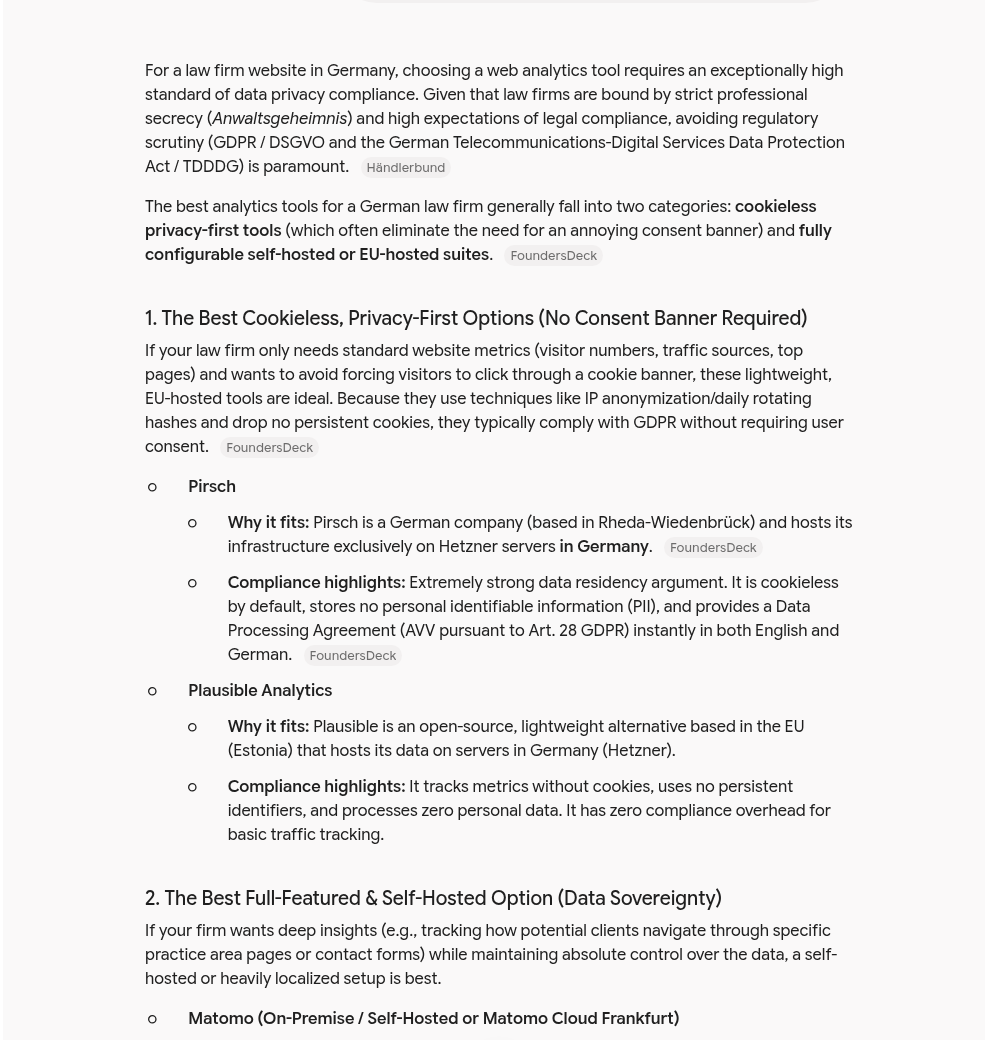
For a law firm website in Germany, choosing a web analytics tool requires an exceptionally high standard of data privacy compliance. Given that law firms are bound by strict professional secrecy (Anwaltsgeheimnis) and high expectations of legal compliance, avoiding regulatory scrutiny (GDPR / DSGVO and the German Telecommunications-Digital Services Data Protection Act / TDDDG) is paramount.
The best analytics tools for a German law firm generally fall into two categories: cookieless privacy-first tools (which often eliminate the need for an annoying consent banner) and fully configurable self-hosted or EU-hosted suites.
1. The Best Cookieless, Privacy-First Options (No Consent Banner Required)
If your law firm only needs standard website metrics (visitor numbers, traffic sources, top pages) and wants to avoid forcing visitors to click through a cookie banner, these lightweight, EU-hosted tools are ideal. Because they use techniques like IP anonymization/daily rotating hashes and drop no persistent cookies, they typically comply with GDPR without requiring user consent.
Pirsch
Why it fits: Pirsch is a German company (based in Rheda-Wiedenbrück) and hosts its infrastructure exclusively on Hetzner servers in Germany.
Compliance highlights: Extremely strong data residency argument. It is cookieless by default, stores no personal identifiable information (PII), and provides a Data Processing Agreement (AVV pursuant to Art. 28 GDPR) instantly in both English and German.
Plausible Analytics
Why it fits: Plausible is an open-source, lightweight alternative based in the EU (Estonia) that hosts its data on servers in Germany (Hetzner).
Compliance highlights: It tracks metrics without cookies, uses no persistent identifiers, and processes zero personal data. It has zero compliance overhead for basic traffic tracking.
2. The Best Full-Featured & Self-Hosted Option (Data Sovereignty)
If your firm wants deep insights (e.g., tracking how potential clients navigate through specific practice area pages or contact forms) while maintaining absolute control over the data, a self-hosted or heavily localized setup is best.
Matomo (On-Premise / Self-Hosted or Matomo Cloud Frankfurt)
Why it fits: Matomo is the gold standard for privacy-compliant enterprise and professional web analytics in Europe.
Compliance highlights:
Self-Hosted (On-Premise): You can download Matomo and run it on your own server or a secure local web hosting provider. Data never leaves your direct control, satisfying the strictest interpretations of client confidentiality.
Matomo Cloud: If you prefer a managed option, their cloud infrastructure is hosted in Frankfurt/Germany.
Note on configuration: To use Matomo completely without a consent banner under GDPR/TDDDG, you must configure it to anonymize IP addresses completely and ensure no tracking cookies are dropped. Otherwise, it must be paired with a clean Consent Management Platform (CMP).
3. The Enterprise EU Alternative
Piwik PRO
Why it fits: Headquartered in the EU (Poland/Sweden), Piwik PRO was built specifically with strict European data privacy laws in mind.
Compliance highlights: It comes as an all-in-one suite featuring analytics, a tag manager, and a built-in consent manager. All data is stored securely on EU-owned cloud infrastructure, making it a favorite for regulated industries, law firms, and government bodies.
What to Avoid (or Handle with Extreme Care)
Standard Google Analytics (GA4): While Google offers IP masking and data processing terms, standard GA4 relies heavily on cookies and cross-site data identifiers. German data protection authorities (Datenschutzbehörden) have repeatedly scrutinized Google Analytics because user data is fundamentally tied to US servers and infrastructure, risking extraterritorial data access under US surveillance laws. Using GA4 compliantly requires a flawless, bulletproof consent banner that respects opt-outs before any tracking fires—and even then, it remains a frequent target for privacy activist complaints.
Summary Checklist for a German Law Firm:
Sign an AVV (Data Processing Agreement): Ensure you execute an Art. 28 GDPR data processing agreement with your chosen analytics vendor.
Check Server Locations: Prioritize providers whose servers are physically located in Germany or the EU.
Minimize Data Collection: If you choose tools like Pirsch or Plausible, you can often bypass the friction of a cookie banner entirely. If you use Matomo or Piwik PRO, ensure your cookie consent banner correctly blocks tracking scripts until the user explicitly consents.
Text as shown by the app, with page buttons and source badges removed. Marked yellow: the brand; underlined: competitors.
Links in the answer
None.