Question 8: Which analytics tools are a good fit for a law firm website in Germany that must comply with GDPR?
ChatGPT web app (chatgpt.com), web search on, captured 2026-10-31 17:40:08 UTC
MentionedRecommendedLinked to your site
Screenshot
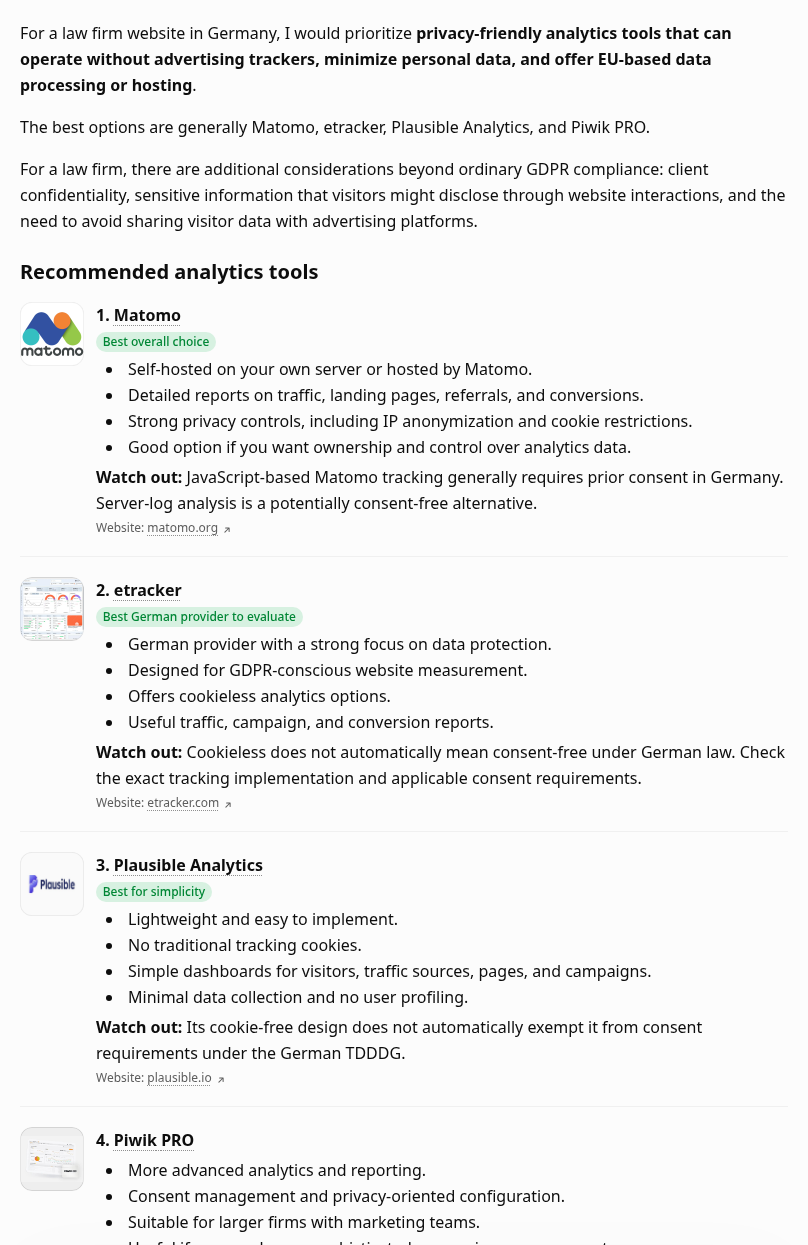
The answer
For a law firm website in Germany, I would prioritize privacy-friendly analytics tools that can operate without advertising trackers, minimize personal data, and offer EU-based data processing or hosting.
The best options are generally Matomo, etracker, Plausible Analytics, and Piwik PRO.
For a law firm, there are additional considerations beyond ordinary GDPR compliance: client confidentiality, sensitive information that visitors might disclose through website interactions, and the need to avoid sharing visitor data with advertising platforms.
Recommended analytics tools
1.
Matomo
Best overall choice
Self-hosted on your own server or hosted by Matomo.
Detailed reports on traffic, landing pages, referrals, and conversions.
Strong privacy controls, including IP anonymization and cookie restrictions.
Good option if you want ownership and control over analytics data.
Watch out: JavaScript-based Matomo tracking generally requires prior consent in Germany. Server-log analysis is a potentially consent-free alternative.
Website: matomo.org
2.
etracker
Best German provider to evaluate
German provider with a strong focus on data protection.
Designed for GDPR-conscious website measurement.
Offers cookieless analytics options.
Useful traffic, campaign, and conversion reports.
Watch out: Cookieless does not automatically mean consent-free under German law. Check the exact tracking implementation and applicable consent requirements.
Website: etracker.com
3.
Plausible Analytics
Best for simplicity
Lightweight and easy to implement.
No traditional tracking cookies.
Simple dashboards for visitors, traffic sources, pages, and campaigns.
Minimal data collection and no user profiling.
Watch out: Its cookie-free design does not automatically exempt it from consent requirements under the German TDDDG.
Website: plausible.io
4.
Piwik PRO
More advanced analytics and reporting.
Consent management and privacy-oriented configuration.
Suitable for larger firms with marketing teams.
Useful if you need more sophisticated conversion measurement.
Watch out: More functionality and complexity than most small law firms need. Consent is still necessary where required.
Website: piwik.pro
Comparison at a glance
Tool
Data control
Ease of use
Best suited for
Matomo On-Premise
Very high
Medium
Full control
etracker
Provider-dependent
High
German law firms
Plausible
Provider-dependent
Very high
Small firms
Piwik PRO
Provider-dependent
Medium
Larger firms
Important: GDPR versus TDDDG
One particularly important point: GDPR compliance and cookie/tracking compliance are not the same thing.
Germany's §25 TDDDG generally requires prior consent before storing information on, or accessing information from, a visitor's device, unless a statutory exception applies. This can also cover cookieless JavaScript analytics.
The German data protection authorities have taken a relatively strict position on website analytics.
There is a potentially useful alternative: server-side analysis of web server logs. Under certain conditions, this can provide basic audience measurement without accessing visitors' devices.
My recommendation for a German law firm
I would narrow the choice to three options:
Matomo On-Premise with server-log analysis if data sovereignty and maximum control are priorities.
etracker if you prefer a German provider and a relatively straightforward implementation.
Plausible if you only need basic website performance metrics and want a simple interface.
For a small or medium-sized law firm, I would start by evaluating etracker and Matomo.
GDPR compliance checklist
Regardless of which tool you choose, I recommend checking these points before implementation:
Requirement
What to check
Hosting
Prefer EU-based data storage and processing
Data processing agreement
Sign an Article 28 GDPR DPA where applicable
IP addresses
Anonymize or minimize collection
Cookies
Disable unnecessary tracking cookies
Consent
Obtain prior consent wherever required
Data transfers
Check international transfers and subprocessors
Retention
Set short, documented retention periods
Privacy policy
Explain analytics processing transparently
Access control
Restrict analytics access to authorized personnel
Additional consideration for law firms: Avoid sending information about legal enquiries, case types, client names, email addresses, or other potentially confidential details to analytics platforms. For example, a URL containing /family-law/divorce/john-smith/ could inadvertently expose sensitive information.
A practical analytics setup
For most law firm websites, you don't need sophisticated marketing analytics. I would focus on:
Number of visitors and page views.
Most frequently visited practice areas.
Traffic sources (Google, directories, referrals).
Contact page visits.
Clicks on telephone numbers and email links.
Contact form completion rates, measured without collecting submitted information.
This provides enough information to understand whether the website attracts prospective clients without building extensive visitor profiles.
One important question
Are you looking for analytics that work without a cookie consent banner, or are you happy to display a consent banner if necessary?
That distinction makes a significant difference to the recommendation. For a German law firm, I would investigate a server-log-based solution first if avoiding a consent banner is a priority.
Text as shown by the app, with page buttons and source badges removed. Marked yellow: the brand; underlined: competitors.
Links in the answer (4)
| Site | Link |
|---|---|
| matomo.org | https://matomo.org/ |
| etracker.com | https://www.etracker.com/ |
| plausible.io | https://plausible.io/ |
| piwik.pro | https://piwik.pro/ |