Question 7: Self-hosted or hosted privacy-friendly analytics - which is better for a small team, and which products fit each option?
ChatGPT web app (chatgpt.com), web search on, captured 2026-10-31 17:39:33 UTC
MentionedRecommendedLinked to your site
Screenshot
The answer
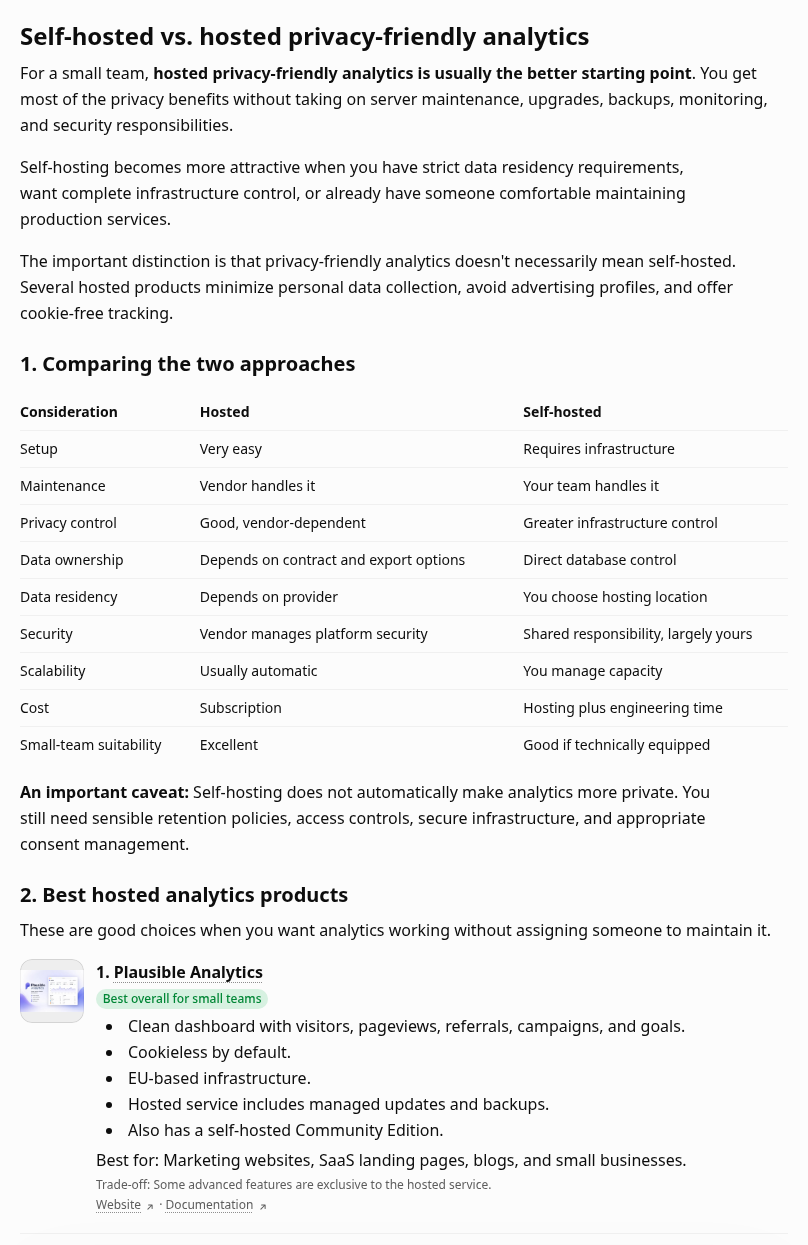
Self-hosted vs. hosted privacy-friendly analytics
For a small team, hosted privacy-friendly analytics is usually the better starting point. You get most of the privacy benefits without taking on server maintenance, upgrades, backups, monitoring, and security responsibilities.
Self-hosting becomes more attractive when you have strict data residency requirements, want complete infrastructure control, or already have someone comfortable maintaining production services.
The important distinction is that privacy-friendly analytics doesn't necessarily mean self-hosted. Several hosted products minimize personal data collection, avoid advertising profiles, and offer cookie-free tracking.
1. Comparing the two approaches
Consideration
Hosted
Self-hosted
Setup
Very easy
Requires infrastructure
Maintenance
Vendor handles it
Your team handles it
Privacy control
Good, vendor-dependent
Greater infrastructure control
Data ownership
Depends on contract and export options
Direct database control
Data residency
Depends on provider
You choose hosting location
Security
Vendor manages platform security
Shared responsibility, largely yours
Scalability
Usually automatic
You manage capacity
Cost
Subscription
Hosting plus engineering time
Small-team suitability
Excellent
Good if technically equipped
An important caveat: Self-hosting does not automatically make analytics more private. You still need sensible retention policies, access controls, secure infrastructure, and appropriate consent management.
2. Best hosted analytics products
These are good choices when you want analytics working without assigning someone to maintain it.
1.
Plausible Analytics
Best overall for small teams
Clean dashboard with visitors, pageviews, referrals, campaigns, and goals.
Cookieless by default.
EU-based infrastructure.
Hosted service includes managed updates and backups.
Also has a self-hosted Community Edition.
Best for: Marketing websites, SaaS landing pages, blogs, and small businesses.
Trade-off: Some advanced features are exclusive to the hosted service.
Website · Documentation
2.
Umami
Best budget-friendly option
Simple, modern analytics dashboard.
No cookies or automatic personal-data collection.
Custom events and website analytics.
Hosted and self-hosted versions.
MIT-licensed open-source software.
Best for: Small development teams that want simplicity, flexibility, and low operating costs.
Trade-off: Less comprehensive than a full Google Analytics replacement.
Website · Documentation
3.
Fathom Analytics
Very simple, polished dashboard.
Cookieless analytics.
Custom events and campaign tracking.
Managed hosting and maintenance.
Best for: Teams that value simplicity and want minimal configuration.
Trade-off: Proprietary hosted product, with no equivalent modern self-hosted edition.
Website
4.
Simple Analytics
Privacy-focused, cookieless tracking.
Minimal dashboard and straightforward reports.
EU-based hosting.
No need to operate analytics infrastructure.
Best for: Teams that want basic website statistics without unnecessary complexity.
Trade-off: Less flexibility and no full self-hosted product.
Website
3. Best self-hosted analytics products
These are appropriate when keeping visitor data on infrastructure you control is important.
1.
Umami
Best overall self-hosted choice
Open-source MIT license.
Relatively straightforward deployment using Docker.
PostgreSQL-backed.
Custom events, dashboards, and website reporting.
No analytics subscription required.
Best for: A small technical team with basic server administration skills.
GitHub repository
2.
Matomo
Best feature-rich option
Full-featured alternative to Google Analytics.
Traffic, events, goals, and ecommerce analytics.
Advanced reporting and optional heatmaps and session recordings.
Open-source On-Premise edition.
Greater control over data storage and retention.
Best for: Teams that need more comprehensive analytics and have someone to maintain the platform.
Trade-off: More complex deployment, maintenance, and privacy configuration.
Website · Documentation
3.
Plausible Community Edition
Open-source AGPL-licensed version.
Lightweight tracking and simple reporting.
Cookieless design.
You control the infrastructure and stored analytics data.
Best for: Teams that want Plausible's philosophy and interface but need to operate their own servers.
Trade-off: Some cloud features aren't included, and releases are less frequent.
GitHub repository
4.
PostHog
Product analytics, event tracking, funnels, and retention.
Session replay, feature flags, and experimentation.
Open-source components and self-hosted deployment.
Hosted cloud option too.
Best for: Software teams that want to understand how customers use an actual application, not just website traffic.
Trade-off: Considerably more operationally demanding than Umami. Self-hosting is resource-intensive.
Website · Self-hosting documentation
5.
GoatCounter
Lightweight, open-source web analytics.
Minimal resource requirements.
Simple traffic and referral reporting.
Self-hostable.
Best for: Small websites, personal projects, and teams that want the smallest possible analytics footprint.
Website · GitHub repository
The strongest distinctions are:
Umami prioritizes simplicity.
Matomo prioritizes reporting depth.
Plausible prioritizes privacy and a clean experience.
PostHog prioritizes product behavior and experimentation.
GoatCounter prioritizes minimalism.
These aren't interchangeable products. In particular, PostHog is more of a product analytics platform than a straightforward website analytics replacement.
4. Quick product comparison
Product
Hosted
Self-hosted
Best use
Plausible
Yes
Yes
Website analytics
Umami
Yes
Yes
Lightweight analytics
Fathom
Yes
No*
Simple reporting
Simple Analytics
Yes
No
Basic website metrics
Matomo
Yes
Yes
Advanced web analytics
PostHog
Yes
Yes
SaaS product analytics
GoatCounter
Yes
Yes
Minimal website analytics
*Fathom Lite exists as an older open-source version, but it isn't equivalent to the current hosted product.
5. What does it cost?
Indicative cost structure, rather than guaranteed quotes:
Product
Hosted cost
Self-hosted cost
Plausible
Paid subscription, entry plans around $9/month
Free software + server
Umami
Free tier available; paid plans available
Free software + server
Matomo
Paid subscription
Free core + server
PostHog
Generous free allowance, then usage-based
Free software + substantial infrastructure
GoatCounter
Free/paid hosted options
Free software + server
Fathom
Paid subscription
Not available as a current equivalent
Remember to calculate the actual cost of self-hosting:
VPS or cloud infrastructure.
Database storage and backups.
Monitoring and security.
Software updates.
Engineering time.
For a small team, saving $10–30 per month isn't necessarily worthwhile if it creates another system someone must maintain.
6. My recommendation by scenario
If you're primarily measuring website traffic
Plausible Cloud
My first choice
Simple, privacy-focused, managed, and easy for non-technical teammates.
If you want to minimize recurring costs
Umami Self-hosted
My first choice
A good balance of functionality, simplicity, and infrastructure control.
If you need detailed analytics
Matomo On-Premise
My first choice
Better when you need comprehensive reporting, ecommerce tracking, and advanced analysis.
If you're building a SaaS application
PostHog Cloud
My first choice
Funnels, retention, feature adoption, session replay, and experimentation are more valuable than basic pageview statistics.
7. Privacy considerations that matter regardless of hosting
Whichever platform you choose, check these things:
Data collection: Does it collect IP addresses, persistent identifiers, device fingerprints, or personally identifiable information?
Cookies: Does it use cookies or other persistent browser storage?
Data residency: Where is visitor data stored and processed?
Data processing agreement: Does the vendor offer a suitable DPA if hosted?
Retention: Can you automatically delete older analytics data?
Access control: Can you restrict access by team member?
Consent requirements: Does your specific implementation require visitor consent?
One important distinction: cookieless tracking doesn't automatically mean consent is unnecessary under every privacy law. The data collected, tracking methods, jurisdiction, and implementation all matter.
8. Final verdict
For a small team, I'd narrow the shortlist to just three:
Plausible Cloud: Best if you want to focus on running your business rather than maintaining infrastructure.
Umami Self-hosted: Best if you have basic technical skills and want ownership without a complicated analytics stack.
Matomo: Best if you need more sophisticated analytics and reporting.
I wouldn't start with PostHog unless you're measuring application behavior, funnels, and product adoption rather than primarily website traffic.
One question that would help narrow this down
Are you primarily looking for analytics for a marketing website, a SaaS/web application, or both?
That distinction changes my recommendation considerably, particularly between Plausible, Umami, Matomo, and PostHog.
Text as shown by the app, with page buttons and source badges removed. Marked yellow: the brand; underlined: competitors.
Links in the answer (14)
| Site | Link |
|---|---|
| plausible.io | Website |
| plausible.io | Documentation |
| umami.is | Website |
| umami.is | Documentation |
| usefathom.com | Website |
| simpleanalytics.com | Website |
| github.com | GitHub repository |
| matomo.org | Website |
| matomo.org | Documentation |
| github.com | GitHub repository |
| posthog.com | Website |
| posthog.com | Self-hosting documentation |
| goatcounter.com | Website |
| github.com | GitHub repository |