Question 4: What is the difference between Matomo and Plausible for a company that needs GDPR-friendly analytics?
ChatGPT web app (chatgpt.com), web search on, captured 2026-10-31 17:34:05 UTC
MentionedRecommendedLinked to your site
Screenshot
The answer
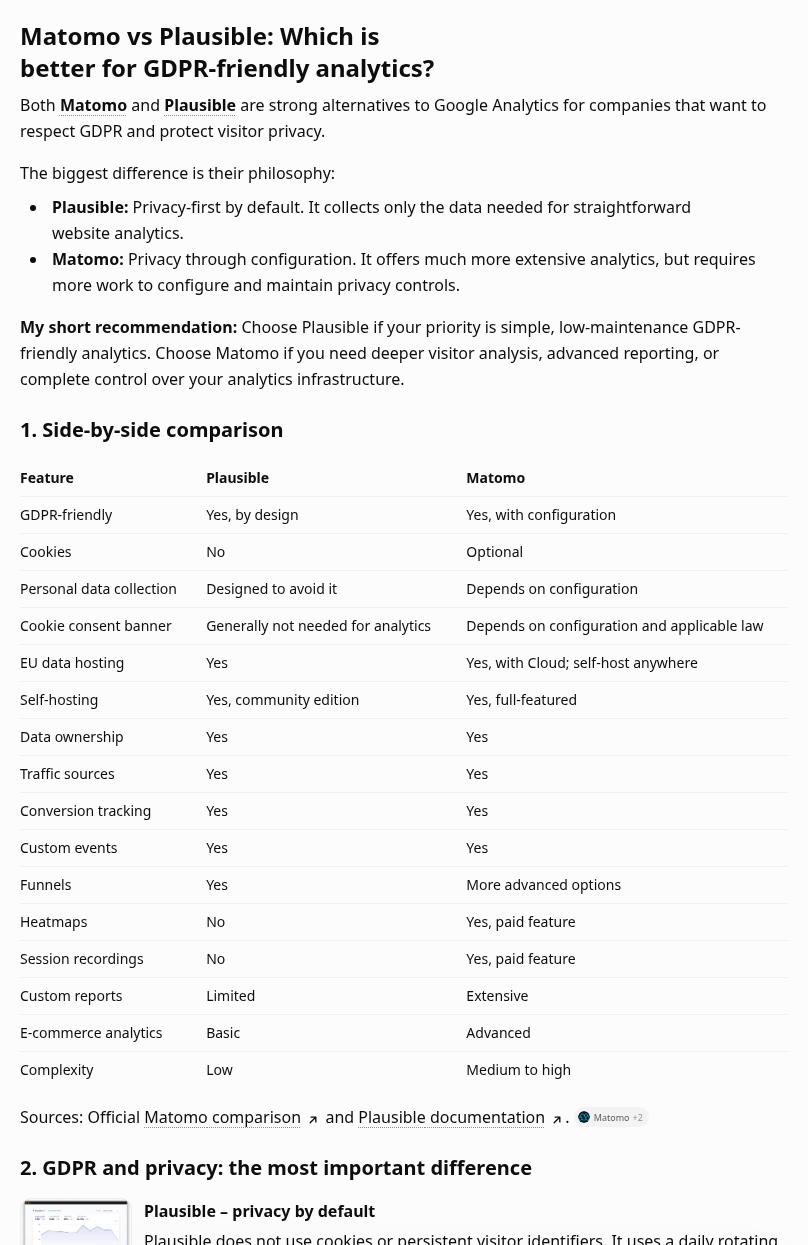
Matomo vs Plausible: Which is better for GDPR-friendly analytics?
Both
Matomo and
Plausible are strong alternatives to Google Analytics for companies that want to respect GDPR and protect visitor privacy.
The biggest difference is their philosophy:
Plausible: Privacy-first by default. It collects only the data needed for straightforward website analytics.
Matomo: Privacy through configuration. It offers much more extensive analytics, but requires more work to configure and maintain privacy controls.
My short recommendation: Choose Plausible if your priority is simple, low-maintenance GDPR-friendly analytics. Choose Matomo if you need deeper visitor analysis, advanced reporting, or complete control over your analytics infrastructure.
1. Side-by-side comparison
Feature
Plausible
Matomo
GDPR-friendly
Yes, by design
Yes, with configuration
Cookies
No
Optional
Personal data collection
Designed to avoid it
Depends on configuration
Cookie consent banner
Generally not needed for analytics
Depends on configuration and applicable law
EU data hosting
Yes
Yes, with Cloud; self-host anywhere
Self-hosting
Yes, community edition
Yes, full-featured
Data ownership
Yes
Yes
Traffic sources
Yes
Yes
Conversion tracking
Yes
Yes
Custom events
Yes
Yes
Funnels
Yes
More advanced options
Heatmaps
No
Yes, paid feature
Session recordings
No
Yes, paid feature
Custom reports
Limited
Extensive
E-commerce analytics
Basic
Advanced
Complexity
Low
Medium to high
Sources: Official Matomo comparison and Plausible documentation .
2. GDPR and privacy: the most important difference
Plausible – privacy by default
Plausible does not use cookies or persistent visitor identifiers. It uses a daily rotating visitor hash to calculate unique visitors without storing IP addresses.
This means:
No analytics cookies.
No persistent visitor tracking.
No cross-site tracking.
No analytics cookie consent banner generally required.
Matomo – privacy through configuration
Matomo offers extensive privacy controls, including:
IP anonymization.
Cookie-free tracking.
Data retention controls.
User opt-out functionality.
Data deletion and export capabilities.
Consent management integrations.
However, not all privacy settings are enabled by default. Your company needs to configure them correctly.
Important: Neither tool automatically makes your entire company GDPR-compliant. You still need to consider your lawful basis, privacy notice, data processing arrangements, and applicable ePrivacy requirements.
3. Analytics capabilities: what do you actually get?
This is where Matomo has a significant advantage.
Analytics capability
Plausible
Matomo
Page views
Yes
Yes
Unique visitors
Yes
Yes
Traffic sources
Yes
Yes
Campaign tracking
Yes
Yes
Goal/conversion tracking
Yes
Yes
Custom events
Yes
Yes
Funnel analysis
Yes, basic
Yes
Visitor-level reports
No
Yes, configurable
Heatmaps
No
Yes
Session recordings
No
Yes
Form analytics
Limited
Yes, additional feature
Advanced segmentation
Limited
Yes
Custom dashboards
Limited
Yes
The practical distinction:
Plausible is excellent for answering:
How many people visit our website?
Where does our traffic come from?
Which pages perform best?
Which marketing campaigns generate traffic?
How many visitors complete a conversion?
Matomo is better for answering:
How do individual visitor journeys unfold?
Where exactly do visitors abandon a conversion funnel?
Which interactions do visitors perform on specific pages?
How do different visitor segments behave?
What happens throughout a complex e-commerce customer journey?
If your marketing team needs detailed behavioral analytics, Matomo is considerably more capable.
4. Hosting and data ownership
Both platforms support data ownership, but they offer different deployment models.
Deployment
Plausible
Matomo
Managed cloud
Yes
Yes
Self-hosted
Yes
Yes
EU hosting
Yes
Yes, Cloud
Hosting in your own infrastructure
Community edition
Full On-Premise
Infrastructure management
Provider-managed in Cloud
Your responsibility when self-hosted
A few important details:
Plausible Cloud: Processes and stores analytics data in the EU. Its DPA applies automatically to customers.
Matomo Cloud: Provides EU data hosting and a Data Processing Agreement.
Matomo On-Premise: Gives your company maximum infrastructure control. You manage security, updates, backups and hosting arrangements.
Plausible Community Edition: Allows self-hosting, but has differences from the managed Cloud offering.
Sources:
5. Costs and maintenance
The pricing structures differ, so compare the total cost rather than just the subscription.
Cost consideration
Plausible
Matomo
Cloud subscription
Based primarily on traffic
Based on traffic and plan
Self-hosted software
Free community edition
Free On-Premise software
Server infrastructure
Required for self-hosting
Required for self-hosting
Maintenance
Low with Cloud
Low with Cloud; higher On-Premise
Advanced features
Relatively limited
Some require paid add-ons
For a small or medium-sized company, Plausible Cloud is often easier to budget and operate.
Matomo On-Premise can be attractive when you already have infrastructure and technical staff to operate it.
6. Which should your company choose?
Choose Plausible if:
You are a small or medium-sized business.
You primarily need website traffic and marketing analytics.
You want to minimize GDPR compliance complexity.
You want to avoid analytics cookies and consent banners where legally permissible.
You don't need individual visitor journeys or session recordings.
You want minimal maintenance.
Best for simplicity
Choose Matomo if:
You have a larger marketing or analytics team.
You need detailed behavioral analytics.
You operate an e-commerce business.
You need heatmaps and session recordings.
You want advanced segmentation and custom reports.
You need full control over where analytics data is stored.
Best for advanced analytics
7. My recommendation
For a company whose primary requirement is GDPR-friendly website analytics without unnecessary complexity, I would choose Plausible.
There are three reasons:
Lower privacy risk: It avoids persistent identifiers and does not store visitor IP addresses.
Less compliance overhead: Its default tracking model makes privacy reviews and consent management simpler.
Less operational complexity: The dashboard is straightforward, and the managed service takes care of infrastructure.
However, if your company has a dedicated marketing analytics team or requires detailed behavioral insights, Matomo is probably the better long-term investment.
One important distinction: Plausible's simpler privacy model does not mean that every possible use of analytics is automatically exempt from GDPR or other privacy requirements. Have your privacy or legal team validate the actual implementation.
Official resources:
Plausible Analytics
Matomo Analytics
Plausible GDPR and compliance documentation
Matomo privacy documentation
One question that would help me make a more precise recommendation
What kind of company are you choosing analytics for?
A. B2B company / SaaS business
B. E-commerce / online shop
C. Corporate website / lead generation
D. Publisher / content website
E. Enterprise / regulated organization
The distinction matters because the value of Matomo's advanced analytics features varies significantly depending on the business model.
Text as shown by the app, with page buttons and source badges removed. Marked yellow: the brand; underlined: competitors.
Links in the answer (6)
| Site | Link |
|---|---|
| matomo.org | Matomo comparison |
| plausible.io | Plausible documentation |
| plausible.io | Plausible Analytics |
| matomo.org | Matomo Analytics |
| plausible.io | Plausible GDPR and compliance documentation |
| matomo.org | Matomo privacy documentation |